All people, companies and projects shown are synthetic Rillsoft sample data – from the shipped industry packages or, where stated, from a test project.
The prompt
Which projects do not keep their committed dates? Take the fixed milestones from the status date in Rillsoft Project as committed dates and find those that would have to move – with old and new date, the shift in working days and the delayed tasks that lie before them through the dependencies. First ask me for project or portfolio; the reference date is the status date. Say for each project whether the last committed date holds. Projects without fixed dates are “not rated”. Do not change the plan.Read-only mode is enough
Show the detailed prompt
Create a delivery date risk list from Rillsoft Project.
First ask me for:
- Scope: project or portfolio (name the open one and let me confirm),
- Thresholds: name the default and ask whether it applies – amber up to 5, red above 5 working days of shift.
The reference date is the status date; name it.
Data, read-only:
- Project structure with float: a committed date is a fixed milestone from the status date. A negative start float on a committed date means it would have to move by that many calendar hours. From that, calculate the new date and the shift in working days using the project's calendar.
- If the float values are missing, say so and do not rate.
- Delayed tasks from the conflict list, only with a delay above 0. A cause of an endangered date is a delayed task that lies before it through the dependencies.
- Do not recalculate dates yourself; do not change the plan.
Report:
1. Header with scope, reference date and source.
2. Key findings with figures: for each affected project how many commitments move and whether the last committed date holds, the largest shift, the delayed tasks before it, how many projects keep all commitments.
3. Table of endangered dates: project, date name, date, would move to, shift in working days, rating with symbol and colour; largest shift first.
4. Table per project: fixed dates, of which at risk, last committed date with “holds” or “moves”, light; projects without fixed dates “not rated”.
5. Causes per endangered date.
6. Data basis and rules.In your words
- Delivery capability: Which delivery dates in the portfolio are shaky? For every endangered milestone I want to see the old and the new date.
- Before the customer meeting: Does Assembly line MX-200 keep its committed dates? If not: by how many working days and because of which tasks?
- Stricter: List the endangered delivery dates, but red from a shift of three working days.
What you need
- An open project or portfolio with maintained actual progress and a set status date.
- Committed dates as fixed milestones – Rillsoft Project has no separate field for delivery dates.
- Dependencies between tasks so the AI can find the causes; without them the list shows the endangered dates only.
- Read-only mode is enough: the AI reads project structure, float, calendars and the conflict list and changes nothing.
What you get
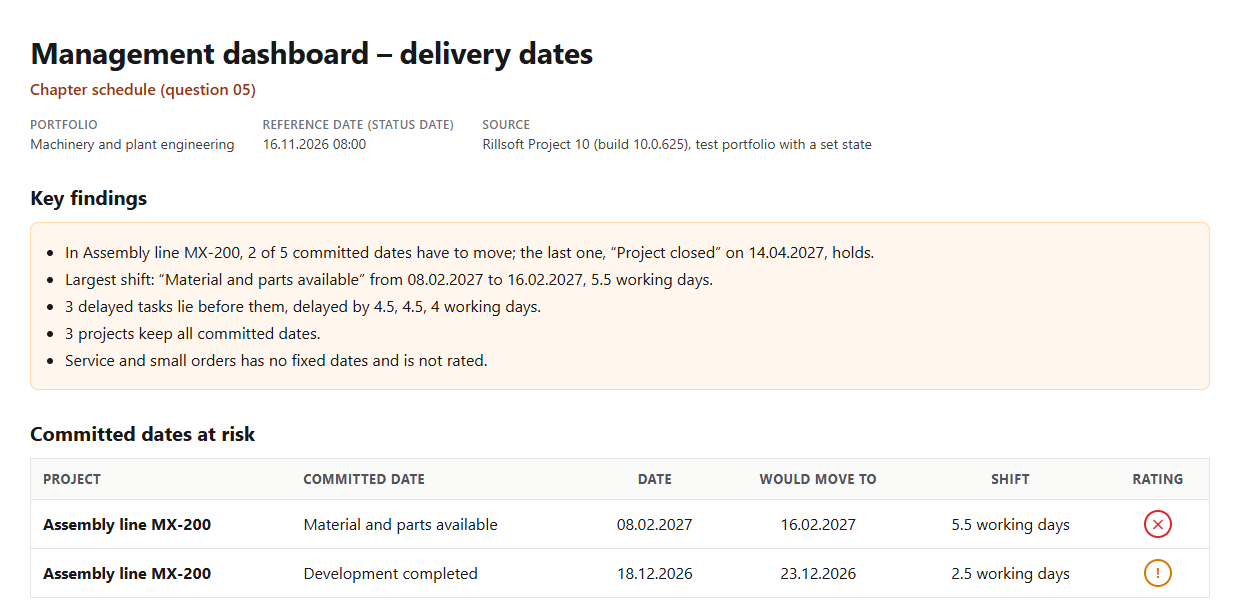
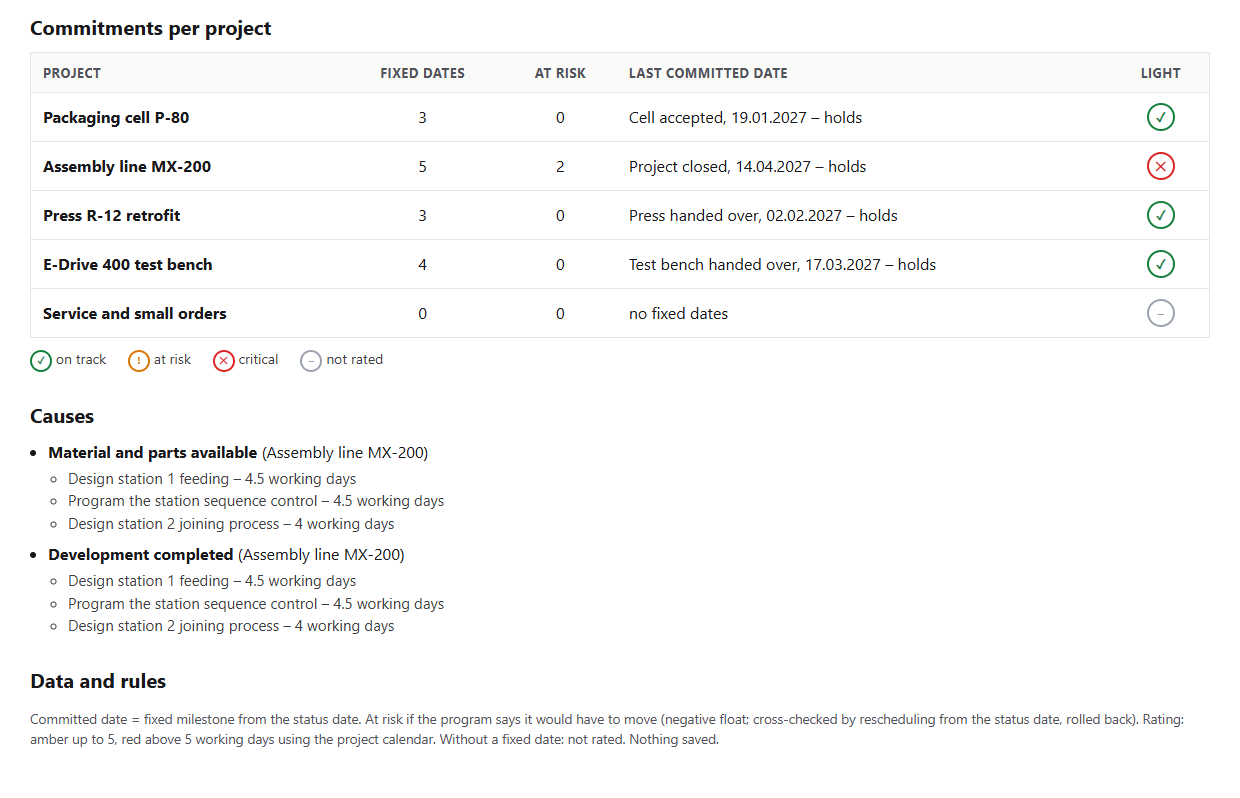
A risk list with key findings, two tables and the causes. In the test portfolio Machinery and plant engineering (five projects, status date 16 Nov 2026 and a backlog in two projects set for the test) four projects have 15 committed dates from the status date. In Assembly line MX-200 two of them have to move: “Material and parts available” from 8 Feb to 16 Feb 2027 (5.5 working days, red) and “Development completed” from 18 Dec to 23 Dec 2026 (2.5 working days, amber). The last committed date, “Project completed” on 14 Apr 2027, holds.
Three delayed tasks with 4.5, 4.5 and 4 working days of delay lie before both dates, among them “Design station 1 feeding”. The other three projects with commitments keep all of them; Service and small orders has no fixed dates and is not rated. Press R-12 retrofit has a delayed task but no endangered date – the delay is within the float.
Why it is useful
For management, what counts is whether committed dates hold. The conflict list shows delayed tasks, but not whether a customer will notice. Rillsoft Project calculates the float up to every fixed date; if it is negative, the date would have to move. The AI turns that into a list with the new date, working days and the tasks that push the date – without touching the plan.How the answer is produced
The AI reads the project structure with float and takes the fixed milestones from the status date as commitments. A negative start float is the number of calendar hours by which the date would have to move; from that it calculates the new date and, with the project calendar, the working days. Through the dependencies it goes back from the endangered date and names the delayed tasks from the conflict list that lie before it. In the test run, Rillsoft Project named exactly the same dates with the same new dates when rescheduling from the status date.rillsoft_project_tree_get rillsoft_calendar_list rillsoft_project_conflict_list
Limits
Commitments are fixed milestones; dates that exist only in a contract are invisible to the AI. The list rates the plan at the status date, not a forecast. Causes are delayed tasks in the dependency chain – without dependencies there are no causes. Float runs up to the next fixed frame. The question belongs to the catalogue of management questions; the same figure sets the schedule light in the overall status. The product page of Rillsoft Project describes scheduling and conflict lists. Related prompts:Try it
Get started- Industry package
Machinery and plant engineering.rpp- Product version
- Rillsoft Project 10 (Build 10.0.625)
- Last verified
- 2026-10-16
- Verification
- Figures and statements verified on the named sample package against the named product build – MCP session, view and report; German and English package with identical figures.