All people, companies and projects shown are synthetic Rillsoft sample data – from the shipped industry packages or, where stated, from a test project.
The prompt
Which resource moves would ease the largest bottleneck? In Rillsoft Project take the role with the largest shortfall from the capacity comparison per role on the day scale, its bottleneck days and the open tasks of this role that run on bottleneck days. Query the candidate list per task and name the people of the role with free capacity, availability and schedule conflict – without schedule conflict first. First ask me for project or portfolio, period and unit; the reference date is the status date. Assign nobody and calculate no effect; mark everything as a proposal. Reset the view afterwards and save nothing.Read-only mode is enough Licence-dependent function
Show the detailed prompt
Create proposals for resource moves against the largest bottleneck from Rillsoft Project.
First ask me for:
- Scope: portfolio or project (name the open one and let me confirm),
- Period: start and end (if I give none, suggest the project period),
- Unit: name the one set in the project,
- Role: the default is the role with the largest shortfall; ask whether another one is meant.
The reference date is the status date; name it.
Data, read-only:
- Staff capacity comparison per role, absolute values with capacity, time filter on the period, time scale day: shortfall per role as the sum of the days with demand above supply; bottleneck role and bottleneck days.
- Project structure: open tasks with an assignment of the bottleneck role that run on bottleneck days – project, period, bottleneck days, quantity of the role, staffed people (approximation over the task duration).
- Candidate list per task: people of the role with free capacity, availability, schedule conflict and whether they are already assigned; without schedule conflict first, then by free capacity.
- Assign nobody, reschedule nothing, calculate no effect – that would only exist by assigning and undoing. Reset the view, save nothing.
Report:
1. Header with scope, reference date, period, unit and source.
2. Key findings with figures: bottleneck role with shortfall and bottleneck days; tasks and projects, of which not fully staffed; tasks with a candidate without schedule conflict and the most frequent person; tasks without such a candidate; the note that nothing is assigned and no effect is calculated.
3. Table of the roles with a shortfall, bottleneck role first.
4. Table of the tasks: project, task, period, bottleneck days, staffed of quantity, candidates, without schedule conflict.
5. Per task the candidates with free, available, schedule conflict, already assigned.
6. Data and rules.In your words
- Resource meeting: Who could take over the electrical design tasks on the bottleneck days? Per task the candidates without schedule conflict – proposal only.
- Another role: Not the role with the largest shortfall but Purchasing and scheduling: which tasks run on bottleneck days, and who would be free?
- One project: Which tasks of Assembly line MX-200 need the bottleneck role on bottleneck days, and which candidates does the program name for them?
What you need
- An open project or portfolio with roles in the resource pool, people per role and role assignments on the tasks.
- A licence with resource management so the candidate list per task is available.
- Read-only mode is enough: the AI reads capacity comparison, project structure and candidate lists, assigns nobody and saves nothing.
What you get
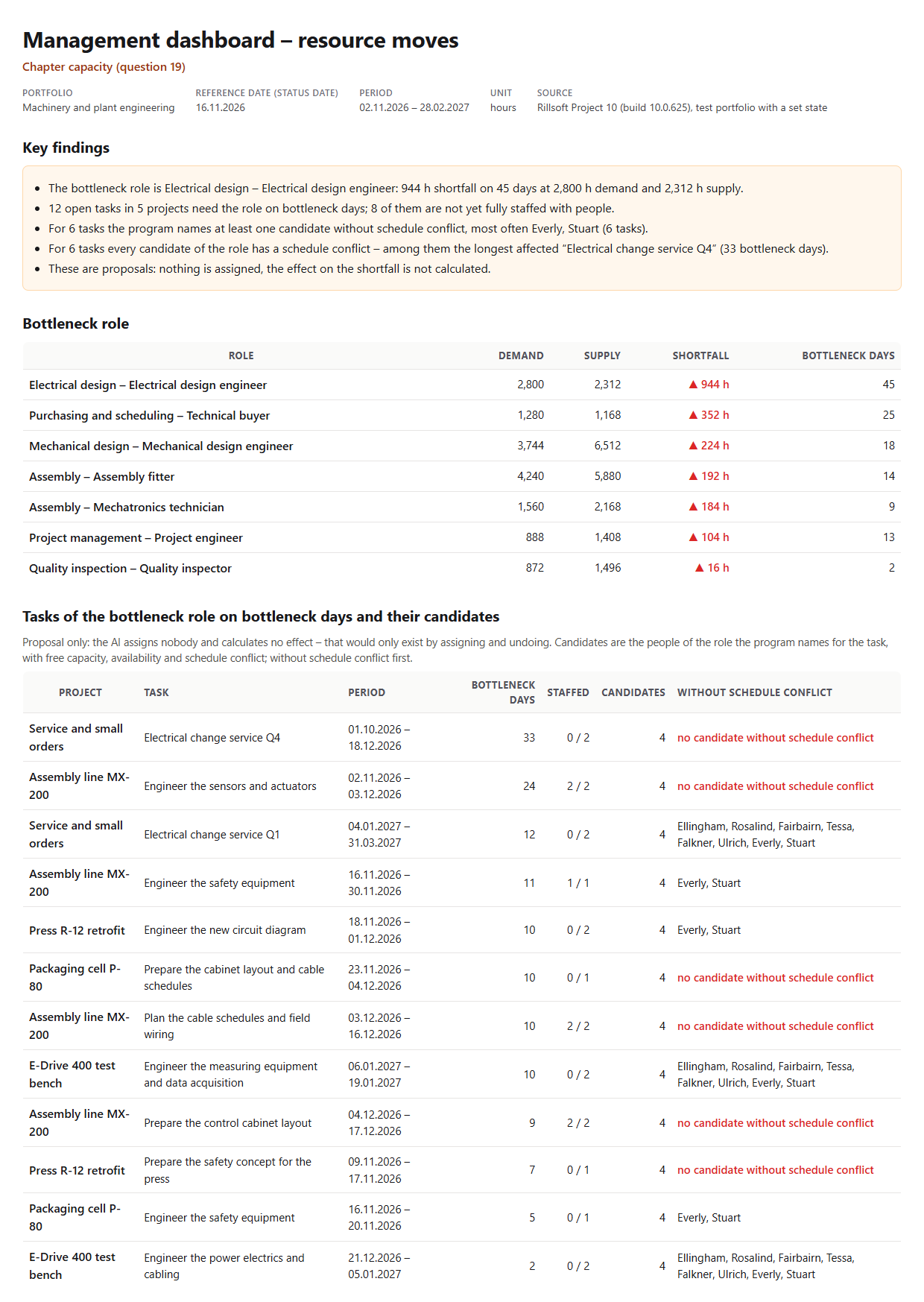
Proposals with key findings, the bottleneck role, a table of the tasks and the candidates per task. In the test portfolio Machinery and plant engineering (five projects, status date 16 Nov 2026 and a backlog in two projects set for the test) Electrical design is the bottleneck role: 944 hours of shortfall on 45 days between 2 Nov 2026 and 28 Feb 2027. Twelve open tasks in five projects need the role on bottleneck days, eight of them are not yet fully staffed with people. For six tasks the program names at least one candidate without schedule conflict, most often the same person – who cannot take them all, as the report says. For the other six, among them “Electrical change service Q4” with 33 bottleneck days, each of the four candidates has a schedule conflict.
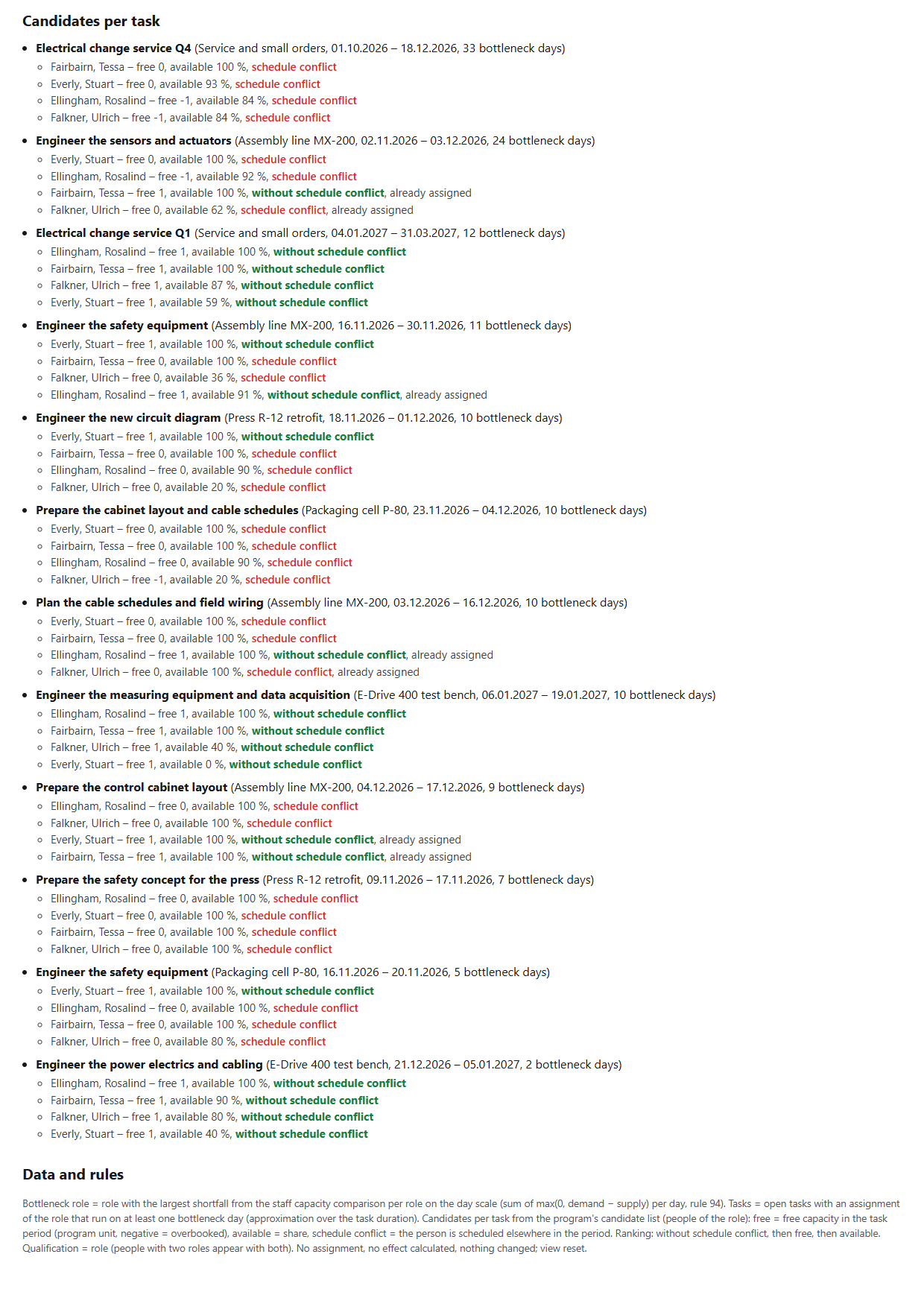
Per task the four people of the role are listed with free capacity, availability and schedule conflict. Nothing is assigned, the effect on the shortfall is not calculated – that would only work by assigning and undoing.
Why it is useful
Whoever wants to ease a bottleneck does not need the overload list but candidates: who of the same role would be free, and where? Rillsoft Project calculates the shortfall per role and day and knows per task the suitable people with availability and schedule conflict. The AI links both from the bottleneck into proposals per task – without writing an assignment.How the answer is produced
The AI remembers the view, reads the capacity comparison per role on the day scale with a time filter and determines the role with the largest shortfall and its bottleneck days; it resets the view. From the project structure it takes the open tasks with an assignment of this role whose duration contains bottleneck days and queries the program’s candidate list for them. Per task it ranks the people of the role: without schedule conflict first, then by free capacity and availability. In the test run the bottleneck role matched the prompt Overloaded roles, every task had a candidate list, and no writing tool was called.rillsoft_view_state_get rillsoft_project_tree_get rillsoft_view_state_apply rillsoft_timescale_apply rillsoft_analysis_report_get rillsoft_task_resource_candidate_list
Limits
Proposal only: the AI assigns nobody and calculates no effect – that is shown by the prompt Capacity after rescheduling through assigning and undoing. Qualification is the role; one person without schedule conflict cannot take over all tasks. The tasks on bottleneck days are an approximation over the task duration. The question belongs to the catalogue of management questions; the bottleneck role comes from the prompt Overloaded roles, candidates for a single task from the prompt Candidates for a task. The product page of Rillsoft Project describes resource management. Related prompts:Try it
Get started- Industry package
Machinery and plant engineering.rpp- Product version
- Rillsoft Project 10 (Build 10.0.625)
- Last verified
- 2026-10-17
- Verification
- Figures and statements verified on the named sample package against the named product build – MCP session, view and report; German and English package with identical figures.