All people, companies and projects shown are synthetic Rillsoft sample data – from the shipped industry packages or, where stated, from a test project.
The prompt
Which projects have the highest schedule risk? Rank the projects in Rillsoft Project by three figures: first the largest shift of a commitment (fixed milestone from the status date, from the negative start float) in working days, then the number of open tasks without finish float on the critical path, then the share of the shortfall in percent of demand. First ask me for portfolio or projects and period; the reference date is the status date. Give per project the lights schedule, progress, resources and a card with “why” and marked recommendations. Undo every plan change and save nothing.Changes the project (one undo step)
Show the detailed prompt
Create a ranking of the projects by schedule risk from Rillsoft Project.
First ask me for:
- Scope: portfolio or selected projects (name the open one and let me confirm),
- Period: start and end for the resources (if I give none, suggest the project period),
- Thresholds: name the defaults and ask whether they apply – schedule amber up to 5, red above 5 working days; progress amber above 5, red above 15 percentage points; resources amber above 0, red above 10 percent.
The reference date is the status date; name it.
Data in one pass:
- Commitments: fixed milestones from the reference date; a negative start float is the shift in calendar hours – calculate the new date and the working days by the project calendar from it; causes are delayed tasks in the dependency chain before them.
- Critical path: frames = fixed milestones from the reference date (otherwise the project finish); from every frame backwards through the dependencies the open tasks without finish float; per project their number, the longest chain and the next critical task.
- Progress: actual from the tree, planned via recalculation at the reference date, then undo and check the actual; gap in percentage points.
- Resources: capacity comparison per role and per role and project on the day scale in the period; share of the shortfall per project in hours and percent of demand, largest role.
- Reset the view, undo every plan change, save nothing.
Ranking: descending by shift of the commitment in working days, then number of path tasks without finish float, then resources in percent. Risk level: red for a moving commitment, amber for a path without slack, not rated without commitment and path.
Report:
1. Header with scope, reference date, period and source.
2. Key findings with figures: the project with the highest risk and its three figures; per further project rank, commitments, path tasks, resources; whether the order differs from the attention list; no forecast.
3. Table: rank, project, schedule with working days, tasks without finish float on the path, resources, progress, risk level.
4. Per project a card with “why” (the colouring figures) and “to clarify” (recommendation from one figure, marked).
5. Data and rules.In your words
- Steering committee: Which of our projects is most at risk on schedule – and why? Ranking by commitments, critical path and shortfall.
- Schedule only: Rank the projects only by the shift of their committed dates in working days; path and resources only as an addition.
- Stricter: Schedule risk per project, but red already from three working days of shift.
What you need
- An open portfolio with fixed milestones as commitments, dependencies, maintained actual progress and a set status date.
- Write access for the MCP server, because the planned progress needs a recalculation with undo; the plan stays unchanged.
- Roles with people in the resource pool so the shortfall per project can be calculated.
What you get
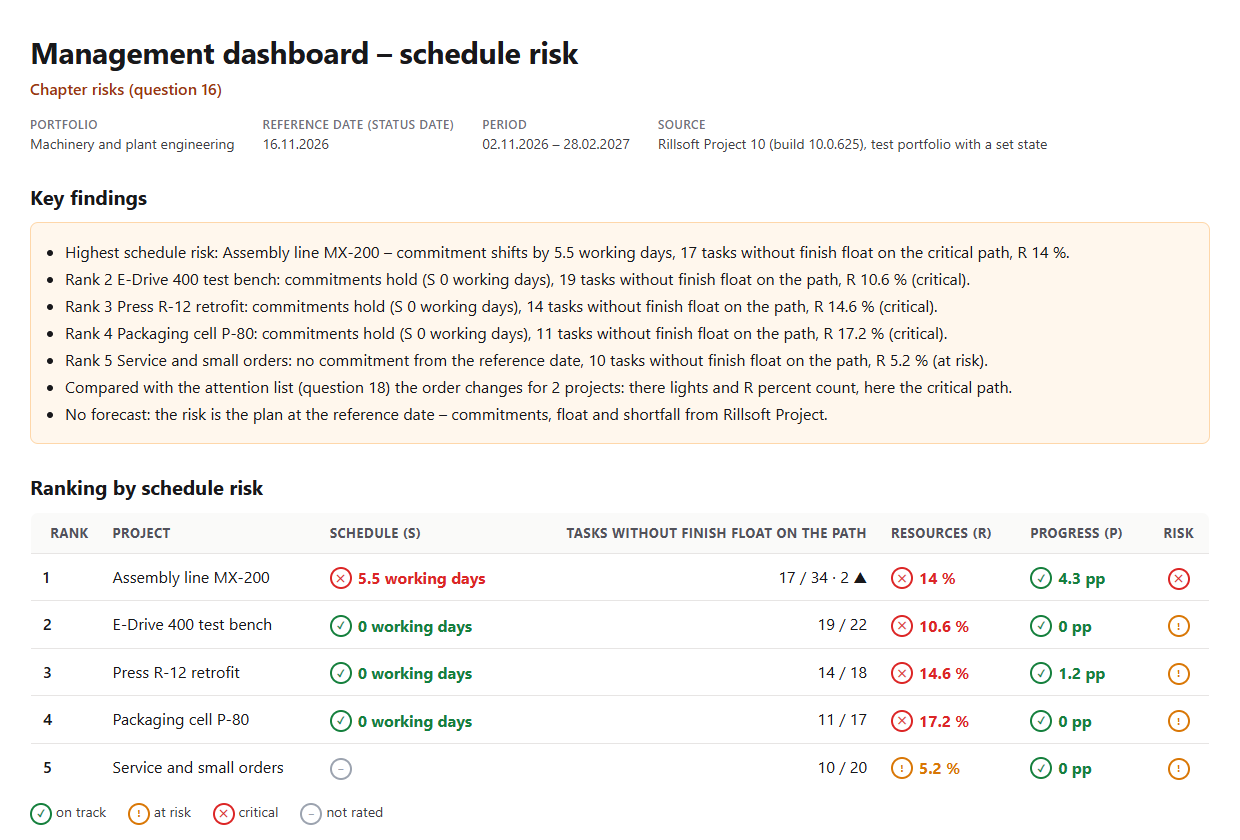
A ranking with key findings, a table and one card per project. In the test portfolio Machinery and plant engineering (five projects, status date 16 Nov 2026 and a backlog in two projects set for the test) Assembly line MX-200 has the highest schedule risk: the commitment “Material and parts available” would have to move by 5.5 working days, 17 of 34 open tasks lie without finish float on the critical path, the share of the shortfall is 14 percent. Behind it follow E-Drive 400 test bench with 19 path tasks, Press R-12 retrofit with 14 and Packaging cell P-80 with 11; all three keep their commitments. Service and small orders has no commitment and ten tasks without finish float up to the project finish.
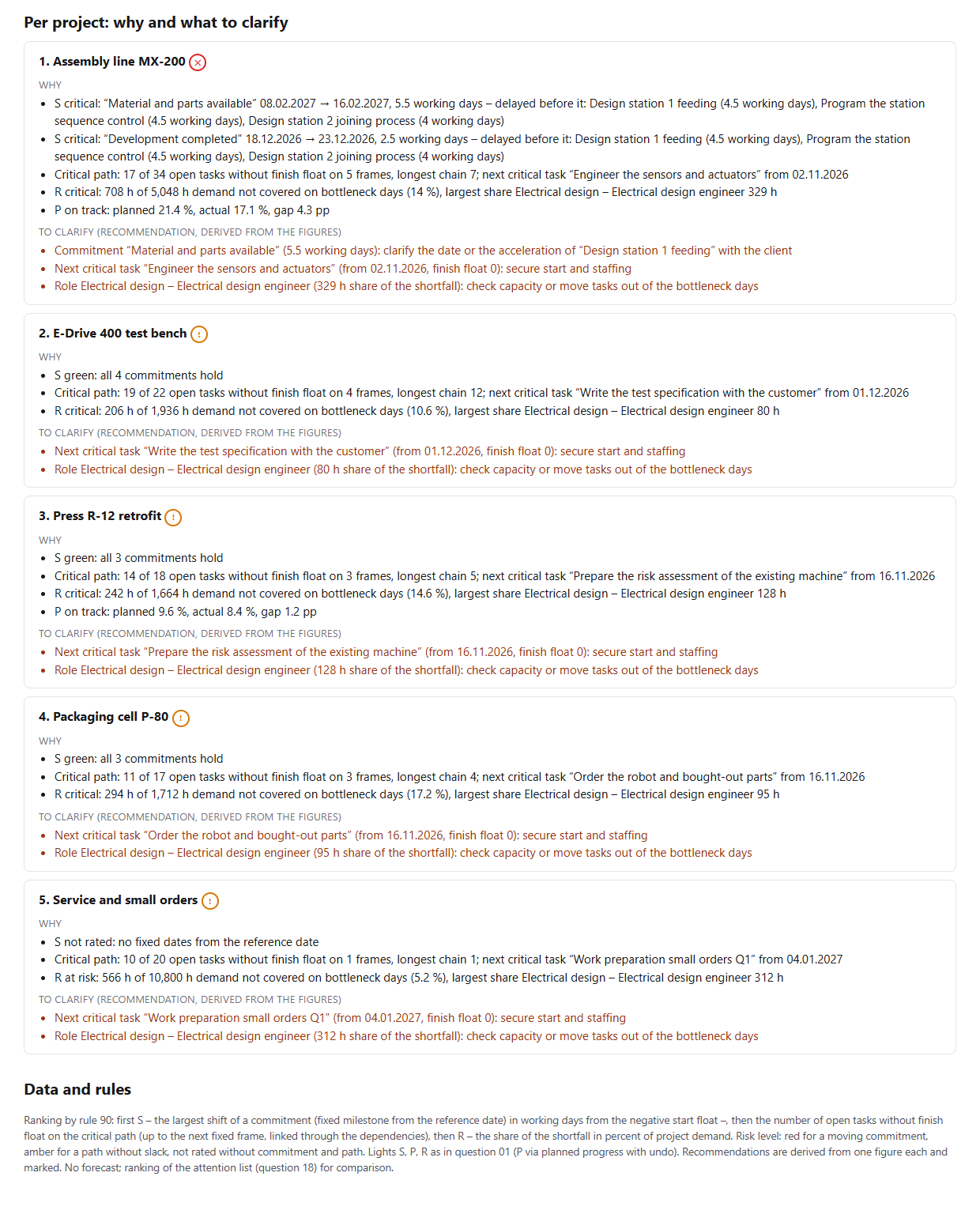
Compared with the attention list, ranks 2 to 4 turn around: there overall light and shortfall in percent count, here the critical path. Per project the card names the commitment with causes, the next critical task and the largest bottleneck role, plus marked recommendations – no forecast, only from the plan at the reference date.
Why it is useful
The attention list says which project needs attention overall; management often asks more narrowly: where is the date in danger? Rillsoft Project provides three figures for that – the float of the commitments, the finish float of the tasks and the shortfall of the roles. The AI ranks the projects by them in a fixed order and explains per project why – in one pass, without changing the plan.How the answer is produced
In one pass the AI reads the project structure with float, calendars, conflict list and the capacity comparison and calculates the planned progress with undo. Commitments are fixed milestones from the reference date, their negative start float the shift; the critical path are the open tasks without finish float up to the next frame; R is the share of the shortfall on bottleneck days. The ranking follows S, then path tasks, then R. In the test run lights and values matched the single questions overall status, attention list and critical path on the same state.rillsoft_project_tree_get rillsoft_calendar_list rillsoft_project_conflict_list rillsoft_task_progress_recalculate rillsoft_history_undo rillsoft_view_state_apply rillsoft_analysis_report_get
Limits
The ranking is a definition from the catalogue (schedule, then path tasks, then resources), not a probability and not a forecast. Projects without a commitment are not rated in S. Progress needs a recalculation with undo. The question belongs to the catalogue of management questions; the overall view is given by the attention list, the paths per project by the prompt Critical path. The product page of Rillsoft Project describes float and milestones. Related prompts:Try it
Get started- Industry package
Machinery and plant engineering.rpp- Product version
- Rillsoft Project 10 (Build 10.0.625)
- Last verified
- 2026-10-17
- Verification
- Figures and statements verified on the named sample package against the named product build – MCP session, view and report; German and English package with identical figures.